This is a neat summary of Christology, as outlined in the first chapter of the New Testament book of Hebrews. Some errant pseudo-Christian new religious movements need to be reminded that Jesus is God, and not a created being.
Showing posts with label Jesus. Show all posts
Showing posts with label Jesus. Show all posts
Wednesday, February 11, 2026


Friday, March 29, 2024
It's Friday, but Sunday is coming
This spoken word song by Jimmy Needham narrates the life, death and resurrection of Jesus, and challenges the listener to consider the claims of Jesus upon his or her life. May it speak to you as it spoke to me.
Thursday, December 20, 2018
More spiritual snakeoil

Via Facebook, a past acquaintance of mine invited me to an event with American televangelist, Jesse Duplantis. I strongly but politely declined the invitation. There's no way known I'm going to see him. Let me explain why.
Firstly, I have a big problem with his hyper spirituality. These evangelists who claim to have special teaching or extra-biblical revelations trouble me. Duplantis claims that he was caught up in the Spirit and visited heaven, where he met Abraham, King David, Jesus himself, and the apostle Paul. It's interesting that he should meet Paul, because Paul also had a vision of heaven. Does Duplantis see himself as being a modern day version of Paul? Unlike Duplantis, Paul didn't share his vision of heaven to make himself look good. When he described his apostolic credentials in his letters, it wasn't to impress people, but to defend himself against his opponents, the so called super apostles, who undermined him.
Secondly, Duplantis is a well known prosperity preacher. He lives in a lavish mansion, and earlier in the year, made headlines when he allegedly asked his supporters to help him buy a private jet, to be used for ministry purposes. Again, he says that God wanted him to have it, but on the face of it, it looks like he's manipulating people, and that he thinks that travelling around on commercial flights is beneath him.
That Duplantis has such a huge following shows a lack of discernment amongst Christians. I'm disappointed that an Australian church is directly supporting his work. Count me out. So many of these celebrity pastors eventually fall off the pedestals their followers put them on.
Sunday, April 16, 2017
A beautiful set of numbers
The Bible is an inexhaustible treasure of wisdom. I was reminded of this again on Easter Sunday, when I visited a Baptist church in one of Melbourne's outer suburban growth corridors. In his sermon, the pastor quoted from the words of Jesus, recorded in John 19:28 and 30. Just before he died on the cross, Jesus said, "it is finished."
In the Greek language, the word for this phrase is tetelestai. In the Strong's Concordance, the word also means to accomplish, complete, execute, conclude, or discharge a debt. I didn't know that in New Testament times, this same word was written on business documents or receipts when an account was fully paid. John, writing to a Greek speaking audience, deliberately chose this word. Their account with God was settled. Jesus had died to pay for their sins. He also died for the sins of anyone who truly puts their faith in him.
In the Greek language, the word for this phrase is tetelestai. In the Strong's Concordance, the word also means to accomplish, complete, execute, conclude, or discharge a debt. I didn't know that in New Testament times, this same word was written on business documents or receipts when an account was fully paid. John, writing to a Greek speaking audience, deliberately chose this word. Their account with God was settled. Jesus had died to pay for their sins. He also died for the sins of anyone who truly puts their faith in him.
Monday, December 26, 2016
Fairy floss?

Merry Christmas to my reader. My Christmas Day started at the gym. I turned on the video screen on my exercise bike, and lo and behold, Channel 10 was screening controversial televangelist, Joel Osteen's programme. Somewhat impulsively, I picked up my smartphone and took a picture of the screen.
The gym was mostly empty this morning. I couldn't hear what Osteen was talking about. The exercise bike has a headphone jack on it, but I didn't bring mine with me. Judging by his happy expression and body language, I could tell that it was a positive message. Osteen is known for preaching positive sermons.
I don't think that I'm the only Christian who goes to my gym, but I was probably the only one who was there yesterday morning. I thought to myself, I wonder if the other gym patrons had heard of Osteen. If they have, maybe they think he's another shonky American televangelist, just like other ones from recent years, using religion to finance his lavish lifestyle.
These smears are probably unfair. My issue with Osteen is his teaching. He heavily emphasises God's love and encouragement, but seems to overlook the other aspects of his character, such as His justice and holiness.
God could use Joel Osteen's show playing on a television screen in a suburban gym to plant a seed to reach the unreached, and perhaps compel them to look into Christianity more, and come to saving faith in Jesus. If they do, I hope that they find a church that offers more substantial teaching than Joel Osteen offers.
Tuesday, January 05, 2016
Seriously?
I sometimes debate online with atheists and agnostics who sincerely believe that Jesus never existed. I post this summary of a recent article, linked at the foot of this posting, for the benefit of them and any other spiritual seekers.
Firstly, recent archaeological finds reveal that Nazareth existed and was settled in the time of Jesus.
Furthermore, Jews in the time of Jesus believed that there would be a messiah figure who would suffer and die, that Christians always believed in Jesus as being divine, and this was not a later innovation.
The gospels were based on written sources, and not oral transmission, as skeptical New Testament scholars have claimed.
The gospel of Mark, widely believed to be first of the gospels to be written, may have been written 5 to 10 years after Jesus was crucified, and not in the late 60s or early 70s AD as scholars often claim.
Finally, many contemporary authors claim that Jesus was an illiterate peasant. However, looking at the debates between Jesus and the Pharisees in the gospels, Jesus shows a thorough knowledge of Jewish law and scripture.
http://www.theblaze.com/contributions/6-shocking-new-discoveries-about-jesus-of-nazareth/
Firstly, recent archaeological finds reveal that Nazareth existed and was settled in the time of Jesus.
Furthermore, Jews in the time of Jesus believed that there would be a messiah figure who would suffer and die, that Christians always believed in Jesus as being divine, and this was not a later innovation.
The gospels were based on written sources, and not oral transmission, as skeptical New Testament scholars have claimed.
The gospel of Mark, widely believed to be first of the gospels to be written, may have been written 5 to 10 years after Jesus was crucified, and not in the late 60s or early 70s AD as scholars often claim.
Finally, many contemporary authors claim that Jesus was an illiterate peasant. However, looking at the debates between Jesus and the Pharisees in the gospels, Jesus shows a thorough knowledge of Jewish law and scripture.
http://www.theblaze.com/contributions/6-shocking-new-discoveries-about-jesus-of-nazareth/
Thursday, December 24, 2015
One sunken heart
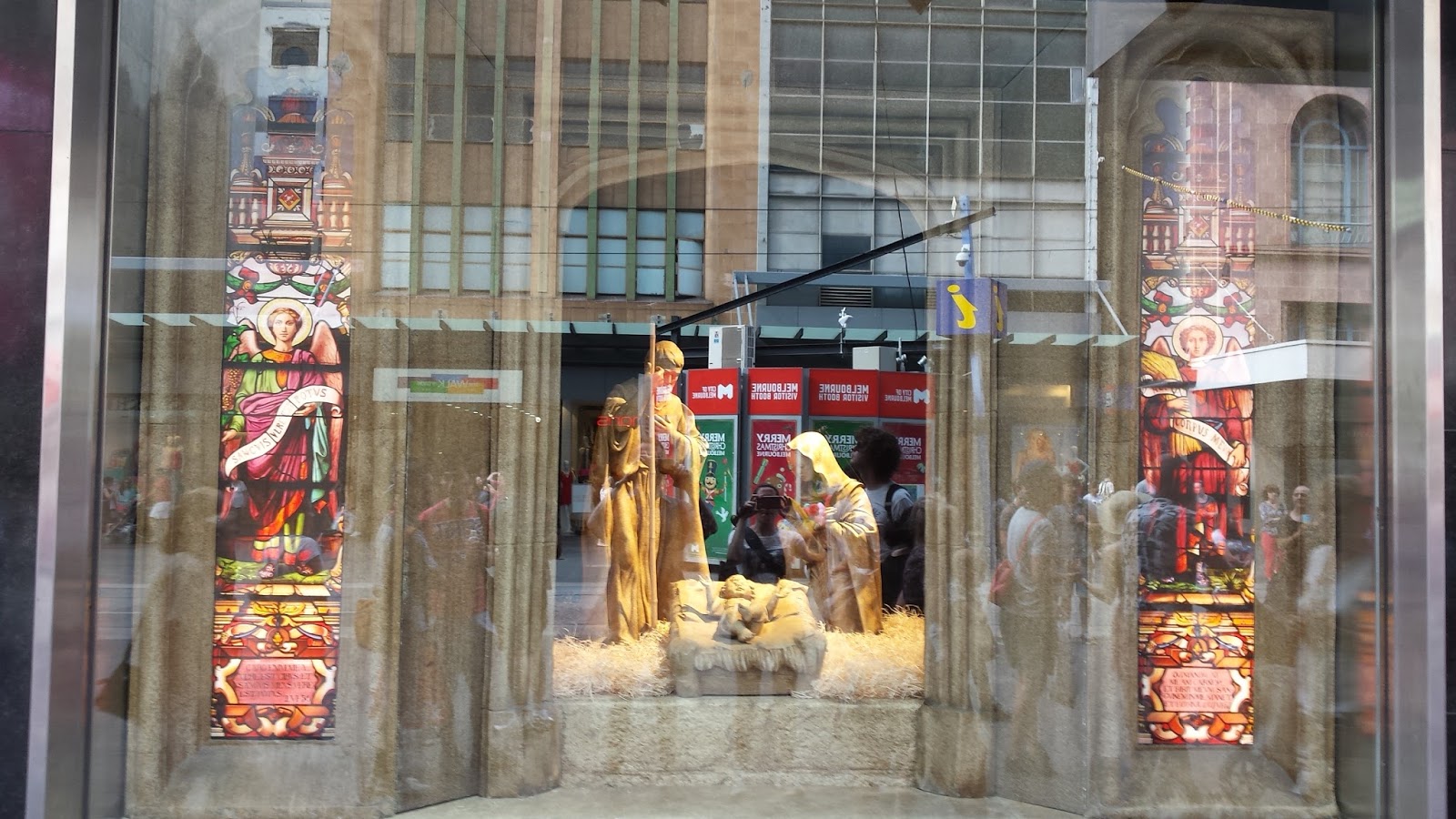 |
| Myer Christmas windows nativity display |
As a nod to the true meaning of Christmas, Myer always puts a nativity scene at the end of the display. Marshalls were required to provide crowd control so that people queued up and filed past the windows in an orderly manner.
My heart sank when I saw that the nativity display seemed to be the only window that didn't have a crowd around it. I wonder how many families skipped looking at that window altogether. Now that the singing of Christmas carols has been banned in government schools, it's going to become more difficult for kids to hear about the true meaning of Christmas.
Thursday, August 28, 2014
People with self respect and respect for others need not apply
Years ago when I first inflicted this blog on a largely indifferent populace, my very first post was on the lowbrow reality television program, Big Brother Australia. Now we come full circle, and with the imminent premiere of its 2014 season, it would seem it's time for me to write about it again.
As a Christian, I'm offended by the latest Big Brother promo. It opens with a shot of Earth from space. The camera then zooms to an aerial shot of the Sydney skyline. To the strains of a reworked version of The Animals Went in Two by Two, we then cut to a shots of the various housemates, including a couple in semi-formal attire, some country types wearing Akubra hats, an Indian woman in traditional dress, some hipster type with a beard and the top button of his shirt done up, and a dread locked surfie dude, all walking along a footbridge to a ship modelled on Noah's Ark.
Some of them smile at each other flirtatiously and hold hands. If previous seasons of the show are anything to go by, this hints at things becoming hot and spicy in the Big Brother house. One of them has a digitally inserted snake's tongue. Is this inspired by the serpent in the garden of Eden?
Then we cut to a shot of host Sonia Kruger. She's standing on top of the ark, wearing a white dress and carrying a wooden staff, with which she strikes the ground. Then a voice from the heavens speaks to her. The clouds part, and she sees a giant eye. This is the Big Brother logo. Ms Kruger speaks directly to camera telling the viewer that this year things will be "stormy, very stormy..."
Cue the cheap looking visual effects, thunder, lightning, and torrential rain. The housemates hurry, pushing and shoving each other to get inside the ark, then the storm suddenly stops, the ark rumbles, and a rainbow appears above it. She continues with a knowing look in her eyes, "...on the inside." Then the Channel 9 voiceover man says words to the effect of "Big Brother; the eye of the storm is coming to Nine."
I surmise that the idea for this came from the recent Hollywood Noah movie. Am I alone here in finding this offensive and blasphemous? The flood narrative of Genesis 6 to 9 is one of the most confronting stories in the Bible, and not something to treat irreverently. All in the name of ratings, Big Brother shows human nature at its worst. They try to dress it up as a sociological experiment, but contestants lie, manipulate and use each other to play the game, and are encouraged to be sexually promiscuous to titillate voyeuristic viewers.
God flooded the earth as judgement against humanity because of the depth of its depravity and sin. Only Noah, his family, and two of every kind of animal were spared. After the flood, God covenanted with humanity never to flood the earth again, as symbolised by the rainbow, but the problem of sin remains. The only solution to this problem is reconciliation with God through Jesus (Matthew 11:27, John 3:18, 14:6, Acts 4:12, 1 John 5:12).
If Big Brother Australia is any indication, reality television has sunk to new lows. This promo unashamedly mocks God and the flood, and that show celebrates all that He abhors. It thumbs its nose at the virtues of decency, respect for others, integrity, and fidelity. Jesus died for everyone involved with this show. I hope they understand that.
https://www.youtube.com/watch?v=RmhrjiQvJW8
As a Christian, I'm offended by the latest Big Brother promo. It opens with a shot of Earth from space. The camera then zooms to an aerial shot of the Sydney skyline. To the strains of a reworked version of The Animals Went in Two by Two, we then cut to a shots of the various housemates, including a couple in semi-formal attire, some country types wearing Akubra hats, an Indian woman in traditional dress, some hipster type with a beard and the top button of his shirt done up, and a dread locked surfie dude, all walking along a footbridge to a ship modelled on Noah's Ark.
Some of them smile at each other flirtatiously and hold hands. If previous seasons of the show are anything to go by, this hints at things becoming hot and spicy in the Big Brother house. One of them has a digitally inserted snake's tongue. Is this inspired by the serpent in the garden of Eden?
Then we cut to a shot of host Sonia Kruger. She's standing on top of the ark, wearing a white dress and carrying a wooden staff, with which she strikes the ground. Then a voice from the heavens speaks to her. The clouds part, and she sees a giant eye. This is the Big Brother logo. Ms Kruger speaks directly to camera telling the viewer that this year things will be "stormy, very stormy..."
Cue the cheap looking visual effects, thunder, lightning, and torrential rain. The housemates hurry, pushing and shoving each other to get inside the ark, then the storm suddenly stops, the ark rumbles, and a rainbow appears above it. She continues with a knowing look in her eyes, "...on the inside." Then the Channel 9 voiceover man says words to the effect of "Big Brother; the eye of the storm is coming to Nine."
I surmise that the idea for this came from the recent Hollywood Noah movie. Am I alone here in finding this offensive and blasphemous? The flood narrative of Genesis 6 to 9 is one of the most confronting stories in the Bible, and not something to treat irreverently. All in the name of ratings, Big Brother shows human nature at its worst. They try to dress it up as a sociological experiment, but contestants lie, manipulate and use each other to play the game, and are encouraged to be sexually promiscuous to titillate voyeuristic viewers.
God flooded the earth as judgement against humanity because of the depth of its depravity and sin. Only Noah, his family, and two of every kind of animal were spared. After the flood, God covenanted with humanity never to flood the earth again, as symbolised by the rainbow, but the problem of sin remains. The only solution to this problem is reconciliation with God through Jesus (Matthew 11:27, John 3:18, 14:6, Acts 4:12, 1 John 5:12).
If Big Brother Australia is any indication, reality television has sunk to new lows. This promo unashamedly mocks God and the flood, and that show celebrates all that He abhors. It thumbs its nose at the virtues of decency, respect for others, integrity, and fidelity. Jesus died for everyone involved with this show. I hope they understand that.
https://www.youtube.com/watch?v=RmhrjiQvJW8
Thursday, June 05, 2014
That's hardly earth shattering, is it?

He used to attend a church, but was treated badly because of his sexuality. This blog is his way of seeking retribution.
He does this by aggregating news stories about bad things that Christians do, both leaders and laypeople. It might be sexual misconduct, financial fraud, murder, bizarre behaviour informed by acting on distorted teaching, spiritual abuse, dysfunction, and the like.
When I look at this blog, it seems to be about mudslinging. It’s all well and good to aggregate news stories about bad things that Christians do, but it’s not offering a corrective. Most thinking Christians are already well aware that the church is in trouble, so I don't find anything earth shattering here either. The perfect church does not exist, and you won't find it on this side of eternity.
Plenty of people have been given the rough end of the stick by churches, which is very sad. Rather than acting in isolation to relentlessly bag the church and Christians out for their shortcomings, I suggest that obtaining some counselling or forming a support group to help each other heal and move on is a more constructive response.
In any case, I’m nothing without Jesus, and I am utterly incapable of living a life that honours God (Isaiah 64:6) without His grace and mercy. There is no room for pride or feelings of superiority, thinking, "I'm glad I'm not like them." (Luke 18:9-14). To any non-Christians who read that blog, and think, “if that’s what Christians are like, then I don’t want to be one,” I say that even if some Christians are hypocrites, and I do mean some, it doesn't mean you’re off the hook with God. No man or woman has an excuse. You need to bow your knee at the foot of the cross, repent, and receive forgiveness and salvation.
Friday, April 18, 2014
It ain't necessarily so
I'm a long time reader of The Age newspaper's weekly television and radio lift out, the Green Guide. One thing that its columnists seem notable for is their disdain and mockery of Christianity. Brad Newsome was prevailed upon to review The Jesus Mysteries, a documentary showing on the National Geographic channel on Good Friday.
Newsome, whose area of interest is science, wrote as follows:
"One mystery is why everyone involved in all these Jesus documentaries seems to accept everything in the gospels as, well, gospel. True, there is next to nothing in the historical record to attest to Jesus' existence, let alone corroborate the gospel stories, so they're short of material to work with. But to proceed on the assumption that everything in the gospels is literally true is like making a doco on Islam and concluding that Muhammad really did fly around on a winged horse. The only scepticism displayed by the scholars and theologians assembled here has to do with extra-canonical matters. One of these is the belief that Jesus travelled to Britain and studied under druids (this began, we are told, with a yarn put about in the Middle Ages by an abbey in need of pilgrims). There's interesting stuff about the symbolism of the nativity stories, and the veneration and demonisation of Mary Magdalene. What would be even more interesting would be a documentary that took a serious look at the Bible as a human book, examining precursors and parallels in pagan religion and literature. Don't hold your breath."
Before I watch the documentary, let me offer the following responses to Newsome's review.
The majority of historians accept that Jesus was a historical figure. Likewise, when I discuss these matters with people, if you want to talk about the historicity of the gospels, I usually start with the gospel of Luke. Luke was a careful historian who compiled his account of the life of Jesus by speaking to eyewitnesses of the events described. Scholarly opinion on when it was written varies, either from 59 to 63 AD, or the 70s or 80s AD. In any event, it was written within the living memory of the eyewitnesses. As Craig S. Keener of Asbury Theological Seminary writes, "very few ancient biographies (the gospels are biographies) were written as close to the time of their subjects as the gospels were."
In any event, scholars believe that the synoptic gospels were written between 50 and 70 AD, and the gospel of John between 70 and 100 AD.
Then he conflates things by comparing Jesus to the prophet Muhammad, and Buraq the flying horse of Islamic belief. When I was at school and writing critiques of films or books, my teachers always marked me or my friends down if we went off on tangents and wrote about other subjects that were irrelevant to what we were writing about. If you don't want to lose marks, stay on topic.
Bart Ehrman is one of the scholars featured in this documentary. In contrast to classical Christianity, which holds that Jesus was God in human form, he believes that the early Christians attributed divinity to Jesus long after his death. Surely having a scholar of Ehrman's profile in this documentary should be enough to satisfy Newsome. Did Newsome know that Ehrman used to be a fundamentalist Christian, then a liberal Christian, but now self-identifies as as agnostic?
On the other hand, I share Newsome's skepticism that Jesus travelled to Britain to study under druids. Because some scholars believe that the gospels tell us nothing about the life of Jesus between the ages of 12 and the commencement of his public ministry as an adult, there is also a body of esoteric literature claiming that during these "missing" years, Jesus visited variously India, Tibet, Persia, Assyria, Greece and Egypt. This is reading things into the text that cannot be supported. It's more likely that he grew up like his peers, staying in his village of Nazareth (Luke 2:52), being schooled in Judaism, and learning the carpentry trade from his earthly father, Joseph (Matthew 13:55, Mark 6:3, Luke 4:22). In other words, Luke makes a summary statement about Jesus growing into adulthood, and he clearly was already well known in his community.
Newsome then sarcastically complains that the documentary doesn't deal with the Bible's precursors and parallels in pagan religion and literature. These objections are commonly made in atheist and skeptic circles. I wonder to how much depth Newsome looked at these issues? Did he watch the Zeitgeist movie, which also makes these claims, which a skeptic acquaintance of mine once suggested to me that I watch, in the hope that it might de-convert me?
Yes, the Bible is a human book. It didn't descend to earth from heaven, gilt edged and leather bound. Its authorship was superintended by God, with its authors writing under the inspiration of the Holy Spirit. It comprises 66 books, written by 40 different authors over a period of hundreds of years, and from beginning to end, it narrates God's plan of redemption for humanity and all of creation.
I'm sure that Newsome is very good at what he does, but in this review he's clearly operating outside of his area of expertise. He's clearly not across his brief. It would be akin to me attempting to write a structural engineering textbook on stresses and tension in bridge design and construction.
http://www.abc.net.au/news/2014-04-18/dickson-tips-for-atheists/539789
http://www.alwaysbeready.com/zeitgeist-the-movie
http://www.craigkeener.com/gospel-truth-luke-11-4/
http://www.smh.com.au/entertainment/tv-guide/friday-april 18-20140416-36qbc.html#ixzz2zDJ5POVy
Newsome, whose area of interest is science, wrote as follows:
"One mystery is why everyone involved in all these Jesus documentaries seems to accept everything in the gospels as, well, gospel. True, there is next to nothing in the historical record to attest to Jesus' existence, let alone corroborate the gospel stories, so they're short of material to work with. But to proceed on the assumption that everything in the gospels is literally true is like making a doco on Islam and concluding that Muhammad really did fly around on a winged horse. The only scepticism displayed by the scholars and theologians assembled here has to do with extra-canonical matters. One of these is the belief that Jesus travelled to Britain and studied under druids (this began, we are told, with a yarn put about in the Middle Ages by an abbey in need of pilgrims). There's interesting stuff about the symbolism of the nativity stories, and the veneration and demonisation of Mary Magdalene. What would be even more interesting would be a documentary that took a serious look at the Bible as a human book, examining precursors and parallels in pagan religion and literature. Don't hold your breath."
Before I watch the documentary, let me offer the following responses to Newsome's review.
The majority of historians accept that Jesus was a historical figure. Likewise, when I discuss these matters with people, if you want to talk about the historicity of the gospels, I usually start with the gospel of Luke. Luke was a careful historian who compiled his account of the life of Jesus by speaking to eyewitnesses of the events described. Scholarly opinion on when it was written varies, either from 59 to 63 AD, or the 70s or 80s AD. In any event, it was written within the living memory of the eyewitnesses. As Craig S. Keener of Asbury Theological Seminary writes, "very few ancient biographies (the gospels are biographies) were written as close to the time of their subjects as the gospels were."
In any event, scholars believe that the synoptic gospels were written between 50 and 70 AD, and the gospel of John between 70 and 100 AD.
Then he conflates things by comparing Jesus to the prophet Muhammad, and Buraq the flying horse of Islamic belief. When I was at school and writing critiques of films or books, my teachers always marked me or my friends down if we went off on tangents and wrote about other subjects that were irrelevant to what we were writing about. If you don't want to lose marks, stay on topic.
Bart Ehrman is one of the scholars featured in this documentary. In contrast to classical Christianity, which holds that Jesus was God in human form, he believes that the early Christians attributed divinity to Jesus long after his death. Surely having a scholar of Ehrman's profile in this documentary should be enough to satisfy Newsome. Did Newsome know that Ehrman used to be a fundamentalist Christian, then a liberal Christian, but now self-identifies as as agnostic?
On the other hand, I share Newsome's skepticism that Jesus travelled to Britain to study under druids. Because some scholars believe that the gospels tell us nothing about the life of Jesus between the ages of 12 and the commencement of his public ministry as an adult, there is also a body of esoteric literature claiming that during these "missing" years, Jesus visited variously India, Tibet, Persia, Assyria, Greece and Egypt. This is reading things into the text that cannot be supported. It's more likely that he grew up like his peers, staying in his village of Nazareth (Luke 2:52), being schooled in Judaism, and learning the carpentry trade from his earthly father, Joseph (Matthew 13:55, Mark 6:3, Luke 4:22). In other words, Luke makes a summary statement about Jesus growing into adulthood, and he clearly was already well known in his community.
Newsome then sarcastically complains that the documentary doesn't deal with the Bible's precursors and parallels in pagan religion and literature. These objections are commonly made in atheist and skeptic circles. I wonder to how much depth Newsome looked at these issues? Did he watch the Zeitgeist movie, which also makes these claims, which a skeptic acquaintance of mine once suggested to me that I watch, in the hope that it might de-convert me?
Yes, the Bible is a human book. It didn't descend to earth from heaven, gilt edged and leather bound. Its authorship was superintended by God, with its authors writing under the inspiration of the Holy Spirit. It comprises 66 books, written by 40 different authors over a period of hundreds of years, and from beginning to end, it narrates God's plan of redemption for humanity and all of creation.
I'm sure that Newsome is very good at what he does, but in this review he's clearly operating outside of his area of expertise. He's clearly not across his brief. It would be akin to me attempting to write a structural engineering textbook on stresses and tension in bridge design and construction.
http://www.abc.net.au/news/2014-04-18/dickson-tips-for-atheists/539789
http://www.alwaysbeready.com/zeitgeist-the-movie
http://www.craigkeener.com/gospel-truth-luke-11-4/
http://www.smh.com.au/entertainment/tv-guide/friday-april 18-20140416-36qbc.html#ixzz2zDJ5POVy
Friday, June 14, 2013
Parallel lives
Nicky Gumbel, best known for creating the Alpha course, has also created a chronological yearly Bible reading plan that I've been working through over the past few weeks.
Here's some commentary about Stephen's speech in Acts 7:20 to 43. The providence of God is the focus of this passage. I've posted it here because of the numerous similarities between the lives of Jesus and Moses, even though they lived hundreds of years apart.
"We see in this passage the extraordinary way in which God planned and prepared for the coming of Jesus. God in his providence foresees the future, and so in a mysterious way anticipates, prepares for it and guides it.
Stephen’s speech rehearses the ways in which God had guided and watched over Israel’s history, and through it prepared for Jesus’ coming. In this section he focuses particularly on Moses.
Moses had said that God would raise up a prophet like him (Deuteronomy 18:15). Peter has already applied this to Jesus (Acts 3:22–23). Now Stephen does the same. He says, ‘This is that Moses who told the Israelites, “God will send you a prophet like me from your own people” ’ (7:37).
Moses was a ‘type’ of Christ. He foreshadowed and prepared the way. There are at least fifteen similarities between Moses and Jesus:
Like Jesus, Moses was ‘no ordinary child’ (v.20). The circumstances surrounding the births of both Moses and Jesus were appropriately extraordinary.
Like Jesus (Matthew 2:16–17), Moses was born at a time when newborn babies were being killed off (Acts 7:19–21).
Like Jesus (Luke 2:40), Moses was noted for his wisdom.‘Moses was educated in all the wisdom of the Egyptians’ (Acts 7:22).
Like Jesus (John 7:46), Moses was ‘powerful in speech and action’ (Acts 7:22).
Like Jesus, Moses had a season of preparation. We know little about the first thirty years of either of their lives. Both spent this time being trained for the task ahead (vv.22–23).
Like Jesus (John 2:16), Moses showed righteous anger at sin (Acts 7:24).
Like Jesus (John 1:11), Moses was sent by God to rescue his people, but was not recognised as such at the time. ‘Moses thought that his own people would realise that God was using him to rescue them, but they did not’ (Acts 7:25).
Like Jesus (2 Corinthians 5:19), Moses aimed at reconciliation. Moses ‘tried to reconcile them’ (Acts 7:26).
Like Jesus (John 5:22), Moses is described as ruler and judge. It was said to Moses, ‘Who made you ruler and judge over us?’ (Acts 7:27).
Like Jesus (Luke 3:22), Moses heard the Lord’s voice (Acts 7:31).
Like Jesus (John 1:14; 2:21), Moses recognised that the holy place was not in a specific religious location, but where God is present. For Moses this was at the burning bush for God said, ‘The place where you are standing is holy ground’ (Acts 7:33).
Like Jesus (John 8:36), Moses set the people free from oppression. The Lord said to Moses, ‘I have heard their groaning and have come down to set them free’ (Acts 7:34).
Like Jesus (4:11), Moses was misunderstood and rejected by his own people. ‘Moses whom they had rejected ... they rejected him’ (Acts 7:35, 39).
Like Jesus (2 Corinthians 1:10), Moses succeeded in delivering his own people. Moses ‘led them out of Egypt’ (Acts 7:36).
Like Jesus (2:36), Moses’ rejection brought God’s judgement, but led to eventual victory (7:42). As the apostle Peter put it on the day of Pentecost, ‘God has made this Jesus, whom you crucified, both Lord and Christ’ (2:36)."
Moses and Jesus were both key figures in God's plan of redemption. Through Jesus, God will eventually reconcile all of creation to Himself, vanquishing sin, suffering, death and evil forever. God and humanity will dwell together upon the earth, just as was intended from the beginning. I cannot help but read these passages as a reminder that if we haven't already, each person has to consider the claims of Christ upon their life, and choose whether to accept or reject the opportunity to be a part of this restored creation.
Here's some commentary about Stephen's speech in Acts 7:20 to 43. The providence of God is the focus of this passage. I've posted it here because of the numerous similarities between the lives of Jesus and Moses, even though they lived hundreds of years apart.
"We see in this passage the extraordinary way in which God planned and prepared for the coming of Jesus. God in his providence foresees the future, and so in a mysterious way anticipates, prepares for it and guides it.
Stephen’s speech rehearses the ways in which God had guided and watched over Israel’s history, and through it prepared for Jesus’ coming. In this section he focuses particularly on Moses.
Moses had said that God would raise up a prophet like him (Deuteronomy 18:15). Peter has already applied this to Jesus (Acts 3:22–23). Now Stephen does the same. He says, ‘This is that Moses who told the Israelites, “God will send you a prophet like me from your own people” ’ (7:37).
Moses was a ‘type’ of Christ. He foreshadowed and prepared the way. There are at least fifteen similarities between Moses and Jesus:
Like Jesus, Moses was ‘no ordinary child’ (v.20). The circumstances surrounding the births of both Moses and Jesus were appropriately extraordinary.
Like Jesus (Matthew 2:16–17), Moses was born at a time when newborn babies were being killed off (Acts 7:19–21).
Like Jesus (Luke 2:40), Moses was noted for his wisdom.‘Moses was educated in all the wisdom of the Egyptians’ (Acts 7:22).
Like Jesus (John 7:46), Moses was ‘powerful in speech and action’ (Acts 7:22).
Like Jesus, Moses had a season of preparation. We know little about the first thirty years of either of their lives. Both spent this time being trained for the task ahead (vv.22–23).
Like Jesus (John 2:16), Moses showed righteous anger at sin (Acts 7:24).
Like Jesus (John 1:11), Moses was sent by God to rescue his people, but was not recognised as such at the time. ‘Moses thought that his own people would realise that God was using him to rescue them, but they did not’ (Acts 7:25).
Like Jesus (2 Corinthians 5:19), Moses aimed at reconciliation. Moses ‘tried to reconcile them’ (Acts 7:26).
Like Jesus (John 5:22), Moses is described as ruler and judge. It was said to Moses, ‘Who made you ruler and judge over us?’ (Acts 7:27).
Like Jesus (Luke 3:22), Moses heard the Lord’s voice (Acts 7:31).
Like Jesus (John 1:14; 2:21), Moses recognised that the holy place was not in a specific religious location, but where God is present. For Moses this was at the burning bush for God said, ‘The place where you are standing is holy ground’ (Acts 7:33).
Like Jesus (John 8:36), Moses set the people free from oppression. The Lord said to Moses, ‘I have heard their groaning and have come down to set them free’ (Acts 7:34).
Like Jesus (4:11), Moses was misunderstood and rejected by his own people. ‘Moses whom they had rejected ... they rejected him’ (Acts 7:35, 39).
Like Jesus (2 Corinthians 1:10), Moses succeeded in delivering his own people. Moses ‘led them out of Egypt’ (Acts 7:36).
Like Jesus (2:36), Moses’ rejection brought God’s judgement, but led to eventual victory (7:42). As the apostle Peter put it on the day of Pentecost, ‘God has made this Jesus, whom you crucified, both Lord and Christ’ (2:36)."
Moses and Jesus were both key figures in God's plan of redemption. Through Jesus, God will eventually reconcile all of creation to Himself, vanquishing sin, suffering, death and evil forever. God and humanity will dwell together upon the earth, just as was intended from the beginning. I cannot help but read these passages as a reminder that if we haven't already, each person has to consider the claims of Christ upon their life, and choose whether to accept or reject the opportunity to be a part of this restored creation.
Tuesday, February 05, 2013
Altar ego
Spend enough time in Christian circles and you'll inevitably have disagreements with other Christians over points of theology and hermeneutics. In most cases you can respectfully agree to disagree, but occasionally they are so clearly in the wrong that they need to be corrected. Often it's in seeing how other Christians misuse Bible verses that you discover what they actually mean.
Matthew 6:3 is a good example of one such verse, which reads as "But when you give to the needy, do not let your left hand know what your right hand is doing." (NIV)
I recently heard of someone who asserted to another Christian that because the left hand is the "unclean" hand, as it was in certain cultures in ancient times, this verse teaches that it is sinful to use your left hand to put money in the offering plate when it's passed around. The mind boggles at how the individual concerned could make such a radical interpretation.
This teaching is part of the Sermon on the Mount. To get the context of a verse, you need to read the verses before and after it. The context of this verse is part of a discourse in Matthew 6:1-18 contrasting true piety with hypocritical piety. Here, Jesus was speaking about religious leaders who gave to the needy not out of a desire to help them, but so that others would think well of them. In verse 2 he called them "hypocrites." Hypokrites is a Greek term for stage actors who wore masks to play various roles. Their giving was part of a facade, to disguise the fact that their hearts were far from God (cf Matthew 23:25-26).
The trumpets that Jesus speaks of may refer to actual trumpets, which were used to announce an especially large gift being given, or he may be referring to the sound of coins being tossed into the trumpet-shaped money chests in the temple used for collecting alms. One of the commentaries I looked at briefly mentions a reference in the Mishnah to a room in the Temple where benefactors could leave their gifts to the poor anonymously.
In verse 3 Jesus was clearly using a figure of speech to make a point about having a humble attitude when giving, to give out of pure motives, solely out of concern for the poor, and to not do it to make yourself look good. Good works have their place but they are of little use if they're done with the wrong motives. As any good Bible scholar would tell you, there is no possible way to support the interpretation given in my anecdote.
Matthew 6:3 is a good example of one such verse, which reads as "But when you give to the needy, do not let your left hand know what your right hand is doing." (NIV)
I recently heard of someone who asserted to another Christian that because the left hand is the "unclean" hand, as it was in certain cultures in ancient times, this verse teaches that it is sinful to use your left hand to put money in the offering plate when it's passed around. The mind boggles at how the individual concerned could make such a radical interpretation.
This teaching is part of the Sermon on the Mount. To get the context of a verse, you need to read the verses before and after it. The context of this verse is part of a discourse in Matthew 6:1-18 contrasting true piety with hypocritical piety. Here, Jesus was speaking about religious leaders who gave to the needy not out of a desire to help them, but so that others would think well of them. In verse 2 he called them "hypocrites." Hypokrites is a Greek term for stage actors who wore masks to play various roles. Their giving was part of a facade, to disguise the fact that their hearts were far from God (cf Matthew 23:25-26).
The trumpets that Jesus speaks of may refer to actual trumpets, which were used to announce an especially large gift being given, or he may be referring to the sound of coins being tossed into the trumpet-shaped money chests in the temple used for collecting alms. One of the commentaries I looked at briefly mentions a reference in the Mishnah to a room in the Temple where benefactors could leave their gifts to the poor anonymously.
In verse 3 Jesus was clearly using a figure of speech to make a point about having a humble attitude when giving, to give out of pure motives, solely out of concern for the poor, and to not do it to make yourself look good. Good works have their place but they are of little use if they're done with the wrong motives. As any good Bible scholar would tell you, there is no possible way to support the interpretation given in my anecdote.
Friday, July 06, 2012
Please explain
Lately, at least partially in reaction to my recent encounter with a Jehovah's Witness, I've been listening to a series of podcasts from the Institute of Biblical Defense on the deity of Jesus Christ. The Institute is an apologetics ministry based in Washington state in the United States. If you're a Christian who wants to learn more about the key doctrines of your faith, then these podcasts are a great resource. If you can get past the bad sound quality, you'll find some meaty teaching there.
The deity of Jesus Christ is one of the essential doctrines of the Christian faith. Believing that God became a man and lived among humanity, ultimately sacrificing his life to break the curse of sin, which made it possible for humanity to reconcile with God, is what makes a Christian a Christian. Without it, Christianity is useless and has nothing to offer anybody.
In theology, you cannot feasibly build a doctrine around a single verse of Scripture. Christ's death and resurrection is an essential part of how he proved that he was God, and there are numerous passages that provide satisfactory proof to the diligent reader that this actually happened, for example, John 20: 24-28.
The section of the gospel of John tells us of how Thomas, one of the disciples, responded when the other disciples came to him with the news that Jesus was alive. Thomas was a broken man. He had spent three years of his life following Jesus, and it had cost him everything. He mourned deeply over the loss of his friend, and wanted to be alone. The other disciples came to him saying, "We have seen the Lord."
Thomas replied, "Unless I see the nail marks in his hands and put my fingers where the nails were, and put my hands into his side, I will not believe it."
Imagine his astonishment when Jesus came to Thomas and invited him to touch his wounds. He suddenly realized that it was true. Jesus had risen from the dead, just as he said he would. Overcome with emotion at this awesome miracle, he cried out to Jesus, "My Lord and my God!" You can find similar confessions elsewhere in John's gospel in John 1:34, 1:49, 4:42, 9:33, 35-38, 11:27, and 16:30.
What does Thomas's confession mean? My friends in the Watchtower Society try to explain this away as Thomas expressing astonishment, but this is not consistent with the text, and it is unlikely that as a devout Jew, Thomas would speak like that, taking God's name in vain. Clearly he is making a statement of faith in Jesus as his Lord and God; one of the most powerful affirmations that an apostle made of Jesus as God. Since this gospel was originally written in Greek, John uses the titles Kurios and Theos. These are equivalent to the Hebrew names Yahweh and Elohim, which in the Jewish mindset are understood to be names and titles of God.
>As John explains a few verses later (20:30), he wants all of his readers to confess Jesus as their Lord and God in the same way that Jesus did. As John makes clear in the prologue of his gospel (1:1, 14, 18), his purpose in writing was to show that Jesus is Messiah and God. If you want to deny these facts, you have the formidable task of explaining away reams of Bible passages, and beliefs that Christians have held since the beginnings of the church in the first century AD.
The deity of Jesus Christ is one of the essential doctrines of the Christian faith. Believing that God became a man and lived among humanity, ultimately sacrificing his life to break the curse of sin, which made it possible for humanity to reconcile with God, is what makes a Christian a Christian. Without it, Christianity is useless and has nothing to offer anybody.
In theology, you cannot feasibly build a doctrine around a single verse of Scripture. Christ's death and resurrection is an essential part of how he proved that he was God, and there are numerous passages that provide satisfactory proof to the diligent reader that this actually happened, for example, John 20: 24-28.
The section of the gospel of John tells us of how Thomas, one of the disciples, responded when the other disciples came to him with the news that Jesus was alive. Thomas was a broken man. He had spent three years of his life following Jesus, and it had cost him everything. He mourned deeply over the loss of his friend, and wanted to be alone. The other disciples came to him saying, "We have seen the Lord."
Thomas replied, "Unless I see the nail marks in his hands and put my fingers where the nails were, and put my hands into his side, I will not believe it."
Imagine his astonishment when Jesus came to Thomas and invited him to touch his wounds. He suddenly realized that it was true. Jesus had risen from the dead, just as he said he would. Overcome with emotion at this awesome miracle, he cried out to Jesus, "My Lord and my God!" You can find similar confessions elsewhere in John's gospel in John 1:34, 1:49, 4:42, 9:33, 35-38, 11:27, and 16:30.
What does Thomas's confession mean? My friends in the Watchtower Society try to explain this away as Thomas expressing astonishment, but this is not consistent with the text, and it is unlikely that as a devout Jew, Thomas would speak like that, taking God's name in vain. Clearly he is making a statement of faith in Jesus as his Lord and God; one of the most powerful affirmations that an apostle made of Jesus as God. Since this gospel was originally written in Greek, John uses the titles Kurios and Theos. These are equivalent to the Hebrew names Yahweh and Elohim, which in the Jewish mindset are understood to be names and titles of God.
>As John explains a few verses later (20:30), he wants all of his readers to confess Jesus as their Lord and God in the same way that Jesus did. As John makes clear in the prologue of his gospel (1:1, 14, 18), his purpose in writing was to show that Jesus is Messiah and God. If you want to deny these facts, you have the formidable task of explaining away reams of Bible passages, and beliefs that Christians have held since the beginnings of the church in the first century AD.
Thursday, May 24, 2012
Glorious to behold
I was prompted to write this post by a painful visit (2 Corinthians 2:1) to my home by one of my good friends (sarcasm is difficult to convey in the written word) from the local Jehovah's Witnesses Kingdom Hall. Amongst other things, they believe that they are the only true church and that all other denominations are apostate, that the doctrine of the Trinity is a heresy, and that Jesus was a created being.
Theologians have written thousands of pages on the divinity of Christ, and it doesn't take that much effort to find a theological dictionary that catalogues every verse of the Bible that either directly refers to or alludes to this as well.
Throughout the Old Testament there are numerous instances where the preincarnate Christ appears on earth, or is seen and described in prophetic visions. Here are a couple of examples of these visions.
The prophet Ezekiel (Ezekiel 1:24-28) describes a heavenly vision of a man, whose appearance gives off a brilliant light. He responds by falling on his face. The opening verses of Isaiah chapter 6 describe a similar vision. By cross-referencing this passage's description of a glorified king, and chapter 53's description of a suffering servant, the gospel of John (John 12:38-41) draws both of these together to show that Isaiah's vision was of the glorified Christ.
Continuing into the New Testament writings, the gospels of Matthew (17:1-2), Mark (9:2-3), Luke (9:28-29) all give accounts of Christ's transfiguration atop Mount Tabor. Although the description they give is not as detailed as that in the prophetic writings, it is clear that the apostles saw a vision of the future glorified Christ as he would appear in heaven (2 Peter 1:16-18). Furthermore, this is the same vision that the apostle Paul saw when Jesus appeared to him in blinding light on the road to Damascus (Acts 9:1-5), and by an elderly apostle John in exile on the island of Patmos in Revelation 1:9-17.
The Old Testament prophets, the gospel writers, and the apostles Paul, Peter, and John all saw the same vision. They were left awestruck, and often fell down in reverence.When I read about these visions for the first time, courtesy of a devotional authored by Selwyn Hughes (1928-2006), I was both moved and amazed. It's things like these that deepen your reverence for Jesus, and help you to understand how scripture shows that Jesus is both Messiah and God.
Theologians have written thousands of pages on the divinity of Christ, and it doesn't take that much effort to find a theological dictionary that catalogues every verse of the Bible that either directly refers to or alludes to this as well.
Throughout the Old Testament there are numerous instances where the preincarnate Christ appears on earth, or is seen and described in prophetic visions. Here are a couple of examples of these visions.
The prophet Ezekiel (Ezekiel 1:24-28) describes a heavenly vision of a man, whose appearance gives off a brilliant light. He responds by falling on his face. The opening verses of Isaiah chapter 6 describe a similar vision. By cross-referencing this passage's description of a glorified king, and chapter 53's description of a suffering servant, the gospel of John (John 12:38-41) draws both of these together to show that Isaiah's vision was of the glorified Christ.
Continuing into the New Testament writings, the gospels of Matthew (17:1-2), Mark (9:2-3), Luke (9:28-29) all give accounts of Christ's transfiguration atop Mount Tabor. Although the description they give is not as detailed as that in the prophetic writings, it is clear that the apostles saw a vision of the future glorified Christ as he would appear in heaven (2 Peter 1:16-18). Furthermore, this is the same vision that the apostle Paul saw when Jesus appeared to him in blinding light on the road to Damascus (Acts 9:1-5), and by an elderly apostle John in exile on the island of Patmos in Revelation 1:9-17.
The Old Testament prophets, the gospel writers, and the apostles Paul, Peter, and John all saw the same vision. They were left awestruck, and often fell down in reverence.When I read about these visions for the first time, courtesy of a devotional authored by Selwyn Hughes (1928-2006), I was both moved and amazed. It's things like these that deepen your reverence for Jesus, and help you to understand how scripture shows that Jesus is both Messiah and God.
Tuesday, March 29, 2011
Mind your p's and q's
I'm not posting this article to condemn people, but I liked it because it's one of the clearest presentations of the gospel I've read in a long time. In a recent sermon, Mark Driscoll, pastor of Seattle's Mars Hill church, set out clearly the need for every person to respond to Jesus. God doesn't want anyone to go to hell, but as he explained to his congregation, there will be consequences for you if you reject Him. Thinking and writing on this topic makes me feel uncomfortable. I have never been an overbearing, in your face Christian, but I have recently been challenged about how selfish it is to keep my beliefs to myself, hence this post.
Tuesday, December 28, 2010
It is finished
This is another post about my visit to a mosque to hear Islamic scholar Yusha Evans. I mentioned earlier that he does not believe in the death and resurrection of Christ. I wrote him a question about this issue, but he chose not to answer it on the night. What follows is an outline of Jesus's death and resurrection, compiled from the four Gospel accounts. I wrote this some years ago on another website, but have reworked it slightly here specifically to engage with Islam.
This is crucial to the Christian faith. The death and resurrection of Jesus is the foundation of Christianity. As a follower of Jesus, I believe that when he died, he offered himself as a sacrifice to pay the penalty for the sins of humanity. Anyone who believes in Jesus has their sins forgiven by God, and has peace with Him. Frankly, without the death and resurrection of Christ, Christianity is useless and not worth believing in. As the apostle Paul wrote:
"But if it is preached that Christ has been raised from the dead, how can some of you say that there is no resurrection of the dead? If there is no resurrection of the dead, then not even Christ has been raised. And if Christ has not been raised, our preaching is useless and so is your faith. More than that, we are then found to be false witnesses about God, for we have testified about God that He raised Christ from the dead. But He did not raise him if in fact the dead are not raised. For if the dead are not raised, then Christ has not been raised either. And if Christ has not been raised, your faith is futile; you are still in your sins." (1 Corinthians 15:12-17).
I read up on Islamic teaching about the resurrection. Rejecting the testimony of the four gospel accounts and the epistles, this teaching asserts that the crucifixion and resurrection of Jesus never took place. God rescued Jesus from the plot to have him crucified and He altered the appearance of another man, possibly Judas Iscariot, so that he resembled Jesus in appearance. It was this man who died on the cross. Shortly after the prophet Jesus was taken back to Heaven.
To answer this teaching, the Bible contains a wealth of information concerning the events surrounding the death and resurrection of Jesus. Jesus predicted these events, even predicting how he would die (Matthew 16:21-28; 17:22-23; 20:17-19, Mark 8:31-38; 9:1; 30-32; 10-32-34, Luke 9:22-27; 43-45; 18-31-34). This is significant because Jesus clearly did know that he would die and be resurrected. It is inconceivable that Jesus would have predicted these events if they were not going to take place.
As we review the Gospel accounts of these events, it will become evident that God did not use a proxy to be crucified in his place. Unlike Jesus, who was divine, this unnamed man would have been born under the curse of sin. As the only sinless man who has ever lived, Jesus was the only one who was worthy to die on the cross as a penalty for the sins of humanity. Let me emphasise again that if this proxy man was crucified in Jesus’ place, the sacrifice would have been worthless, and with it the entire foundation of Christianity.
How did Jesus really die? The Gospel accounts state that Jesus and his disciples travelled to Jerusalem for the Jewish Passover festival. On the night he was arrested, Jesus shared the Passover meal with his disciples. (Matthew 26:17-19, Mark 14:12-16, Luke 27:7-13). He revealed that Judas, one of his disciples, would betray him to his enemies (Matthew 26:20-25, Mark 14:17-21, Luke 22:31-38, John 13:36-38). Judas had already secretly arranged to do this (Matthew 26:14-16, Mark 14:10-11, Luke 22:3-6). When they finished the meal, Jesus and the disciples went to the garden of Gethesemane on the Mount of Olives. There he prayed repeatedly, "My Father, if it is possible, may this cup be taken from me. Yet not as I will, but as You will." He found his disciples asleep, exhausted from their great sorrow. Jesus' anquish was so great that his sweat turned to blood (Matthew 26:30, 36-46, Mark 14:26, 32-42, Luke 22:39-46, John 18:1). Accompanied by a mob of soldiers, Judas arrived. He arranged with his accomplices that he would identify the man to be arrested with a kiss. Judas kissed Jesus, and the mob arrested him and lead him away (Matthew 26:47-55, Mark 14:43-49, Luke 22:47-53, John 18:2-11). The remaining disciples fled, just as Jesus predicted they would do (Matthew 26:56, Mark 14:50-52).
Jesus was brought before Annas, the Jewish high priest, for questioning (John 18:12-14, 19-23). They brought him before Caiaphas and the Sanhedrin, the supreme Jewish court, for trial on charges of blasphemy. Under questioning by the Sanhedrin, Jesus declared himself to be the Messiah (Matthew 26:57, 59-66; Mark 14:53, 55-64; Luke 22:54; John 18:24), inciting his captors to mock, beat, and spit upon him (Matthew 26:67-68; Mark 14:65; Luke 22:63-65). Peter denied knowing Jesus three times, just as Jesus predicted (Matthew 26:69-75; Mark 14:66-72; Luke 22:55-62; John 18:17, 25-27).
Remembering Jesus' words to him, Peter went away and wept bitterly. Peter had no doubt that Jesus would be killed. He knew, as the other disciples did, that it was impossible for him to escape execution, or to organise a proxy to die instead of Jesus. The Sanhedrin ordered Jesus's execution (Matthew 27:1-2; Mark 15:1, Luke 22:66-71). Judas, meanwhile, was overcome with remorse at his betrayal of Jesus. He returned the money his accomplices paid him for his actions, and went away to hang himself (Matthew 27:3-10; Acts 1:18-19). Again, it is highly unlikely that Judas would have done this if he knew that Jesus planned to escape his execution.
Jesus was brought before Pontius Pilate, the Roman Governor of the province of Judea, for further questioning. The Sanhedrin had no power to execute Jesus, so they hoped that he could be sentenced to death under Roman law. However, Pilate found no basis for the charges against Jesus (Matthew 27:11-14; Mark 15:2-5; Luke 23:1-5, John 18:28-38). Pilate sent him to King Herod. Jesus was questioned and mocked again, then returned to Pilate (Luke 23:6-12).
At the time of the Jewish Passover, the Governor had a custom to release a prisoner chosen by the people. They chose to release Barabbas, a notorious criminal (Matthew 27:15-26; Mark 15:6-15; Luke 23:13-25; John 18:39-40; 19:1). Prior to leading Jesus away to be crucified, Pilate's soldiers mocked and beat him. Mocking Jesus's claims to be a king, they thrust a crown of thorns upon his head, and dressed him in a purple robe (Matthew 27:27-31; Mark 15:16-19; John 19:2-3). Once again Pilate sought to have Jesus released, but the religious authorities demanded his death. Pilate accepted their demands (John 19:4-16).
They brought Jesus to Golgotha, a hill overlooking Jerusalem, and a number of his followers watched as he was lead to his death (Matthew 27:32-34; Mark 15:20-23; Luke 23:26-32; John 19:17). Stripped and nailed to a cross, he suffered an agonising and humiliating death. Mary, his mother, watched as her son slowly died (Matthew 27:35-44; Mark 15:24-32; Luke 23:33-43; John 19:18-27). He was abandoned and powerless, separated from his Heavenly Father as he bore the burden of the sins of humanity upon his broken body. He cried out in pain, "My God, my God, why have you forsaken me?" (Matthew 27:45-59; Mark 15:33-36; Luke 23:43-45; John 19:28-29). He cried out again, and knowing that he had accomplished the redemption of humanity, spoke the words, "It is finished." Then he died (Matthew 27:50; Mark 15:37; Luke 23:46; John 19:30). To make sure that he was dead, Roman soldiers removed his body from the cross and pierced his side with a spear, bringing a flow of blood and water (John 19:31-37). Miracles happened. The curtain in Jerusalem's Jewish temple was torn in two. Dead people came back to life. The Roman soldier who stood guard at Jesus's cross was moved to exclaim, "Surely this man was the Son of God." (Matthew 27:51-56; Mark 15:38-41; Luke 23:47-49).
Joseph of Arimathea, a secret follower of Jesus, asked for Jesus's body, and wrapping it in a clean linen cloth, he placed it in his own tomb, sealing the entrance with a large stone. The women who earlier witnessed Jesus's death followed Joseph to the tomb and watched (Matthew 27:57-61; Mark 15:42-47; Luke 23:50-56, John 19:38-42). The chief priests of the Sanhedrin remembered that when Jesus was still alive, he claimed that he would rise from the dead after three days. They wanted to make sure that Jesus was dead, and that his followers would be crushed. To prevent them coming and stealing the body, they persuaded Pilate to place the tomb under guard (Matthew 27:62-66).
On the morning of the third day after Jesus's death, Mary Magdalene, Mary, mother of James, and Salome went to the tomb. To their astonishment, they found that the stone sealing the entrance to the tomb had been rolled away (Matthew 28:1-4; Mark 16:1-4; Luke 24:1-6; John 20:1). When they went inside to investigate further, they found that the tomb was empty. Angels appeared, telling them that Jesus had risen from the dead, just as he said he would do (Matthew 28:5-8; Mark 16:5-8; Luke 24:3-8). The women hurried to tell the other disciples what they had seen. Peter went inside the tomb, and he and another disciple saw the cloth and linen that was used to to wrap Jesus's body lying on the ground (Luke 24:9-12; John 20:2-9). Peter was dumbfounded.
Mary Magdalene remained at the tomb, crying. Angels appeared to her. "Woman, why are you crying?" they asked. She replied, "They have taken my Lord away, and I don't know where they have put him." A man stood behind her. Mary thought that he was the gardener who kept the burial ground. When he spoke her name, she realised that it was Jesus. Filled with joy, she returned to the other disciples, telling them, "I have seen the Lord!" (Mark 16:9-11, John 20:10-18). Jesus then appeared to the other women who visited the tomb, and they clasped his feet and worshipped him (Matthew 28:9-10). Reporting to their superiors what had happened, the tomb guards were bribed to spread a story that Jesus's disciples stole his body (Matthew 28:11-15).
Later that day, two of Jesus's followers were travelling to the village of Emmaus, not far from Jerusalem. Jesus came and walked with them, but they did not recognise him at first. They discussed the events of the previous three days, how Jesus had been arrested and crucified, the reports of the empty tomb, and the women who claimed that Jesus was alive again. Speaking of himself, Jesus responded, "How foolish you are, and how slow of heart to believe all that the prophets have spoken! Did not the Christ have to suffer these things and then enter his glory?" Beginning with Moses and all the Prophets, he explained to them what was said in the Scriptures concerning himself. Only then did they recognise Jesus (Mark 16:12-13, Luke 24:13-32). They returned to Jerusalem immediately to report to the other disciples what happened (Luke 24:33-35). They thought he was a ghost, so Jesus invited them to touch his wounded hands and feet. He then took and ate a piece of fish in front of them (Mark 16:14; Luke 24:36-43; John 20:19-25; 1 Corinthians 15:5). There could no longer be any doubt that Jesus was alive.
John 20:24-28 tells us of how Thomas, one of the disciples, responded when the other disciples came to him with the news that Jesus was alive. Thomas was a broken man. He had spent three years of his life following Jesus, and it had cost him everything. He mourned deeply over the loss of his friend, and wanted to be alone. The other disciples came to him saying, "We have seen the Lord."
Thomas replied, "Unless I see the nail marks in his hands and put my fingers where the nails were, and put my hands into his side, I will not believe it." Imagine his astonishment when Jesus came to Thomas and invited him to touch his wounds. He suddenly realised that it was true. Jesus had risen from the dead, just as he said he would. Overcome with emotion at this awesome miracle, he cried out to Jesus, "My Lord and my God!" These words are very profound. Thomas acknowledged Jesus as Messiah and as God. Jesus affirmed Thomas for his belief in him, just as he did all those who recognised him as Thomas did. Thomas would not have reacted to Jesus in this way if he had not died at all.
Some time later, seven of the apostles spent the night fishing on the Sea of Galilee, and caught nothing. The next morning, Jesus stood on the shore, but they did not realise who he was.
He called out to them, "Friends, have you caught any fish?"
"No," they replied.
He said, "Throw your net on the right side of the boat and you will find some." They did as Jesus said, and they were unable to haul in the net because of the large number of fish (John 21:1-14). This reminded them of their first meeting with Jesus, when he performed a similar miracle (Luke 5:1-11), and provided further proof that Jesus had risen from the grave, and was now back with his followers.
In a powerful act of reconciliation, Jesus reinstated Peter (John 21:15-24). After giving what is known as the Great Commission, the command to spread his teachings throughout the world (Matthew 28:16-20; Mark 16:19-20; Luke 24:50-53, Acts 1:9-12), Jesus told the apostles to wait in Jerusalem until the power of the Holy Spirit came upon them (Luke 24:44-49, Acts 1:3-8). The Holy Spirit was the Comforter and Counsellor Jesus promised to send to them (John 14:15-31, 16: 5-16).
The power of the Holy Spirit came upon the church, empowering it to boldly proclaim Jesus's message of hope and forgiveness from God throughout the world. As we read the remainder of the New Testament, it is impressive to see that the apostles, as the pioneers of the early church, suffered greatly for their faith, and were prepared to lose their lives for the cause of Jesus Christ, as most of them eventually did. They would not have shown such courage, determination, and conviction in their cause if Jesus was less than he claimed to be, and if they were mistaken in believing that Jesus was the Messiah, uniquely chosen by God to provide salvation to humanity. He provided the ultimate proof of these claims in his victory over death, which the apostles had all witnessed. This was not a mass delusion, nor was it a case of mistaken identity. Over a period of several weeks, more than 500 people saw Jesus alive in the days after his resurrection (1 Corinthians 15:6). Jesus was crucified and rose from the dead, just as the Bible says he did. God did not use a proxy to die in his place.
It is highly unlikely that the first Christians would have displayed such commitment, passion and energy in spreading the teachings of Jesus Christ if in fact he was not the Messiah. But they were totally convinced that Jesus was exactly who he claimed to be. He was the Son of God, the Messiah, and the only Saviour of humanity. He alone conquered death, making it possible for all of us, as God's children, to be reconciled with God, receive forgiveness for our sins and escape the penalty of eternal separation from God, and have a relationship with Him.
This is crucial to the Christian faith. The death and resurrection of Jesus is the foundation of Christianity. As a follower of Jesus, I believe that when he died, he offered himself as a sacrifice to pay the penalty for the sins of humanity. Anyone who believes in Jesus has their sins forgiven by God, and has peace with Him. Frankly, without the death and resurrection of Christ, Christianity is useless and not worth believing in. As the apostle Paul wrote:
"But if it is preached that Christ has been raised from the dead, how can some of you say that there is no resurrection of the dead? If there is no resurrection of the dead, then not even Christ has been raised. And if Christ has not been raised, our preaching is useless and so is your faith. More than that, we are then found to be false witnesses about God, for we have testified about God that He raised Christ from the dead. But He did not raise him if in fact the dead are not raised. For if the dead are not raised, then Christ has not been raised either. And if Christ has not been raised, your faith is futile; you are still in your sins." (1 Corinthians 15:12-17).
I read up on Islamic teaching about the resurrection. Rejecting the testimony of the four gospel accounts and the epistles, this teaching asserts that the crucifixion and resurrection of Jesus never took place. God rescued Jesus from the plot to have him crucified and He altered the appearance of another man, possibly Judas Iscariot, so that he resembled Jesus in appearance. It was this man who died on the cross. Shortly after the prophet Jesus was taken back to Heaven.
To answer this teaching, the Bible contains a wealth of information concerning the events surrounding the death and resurrection of Jesus. Jesus predicted these events, even predicting how he would die (Matthew 16:21-28; 17:22-23; 20:17-19, Mark 8:31-38; 9:1; 30-32; 10-32-34, Luke 9:22-27; 43-45; 18-31-34). This is significant because Jesus clearly did know that he would die and be resurrected. It is inconceivable that Jesus would have predicted these events if they were not going to take place.
As we review the Gospel accounts of these events, it will become evident that God did not use a proxy to be crucified in his place. Unlike Jesus, who was divine, this unnamed man would have been born under the curse of sin. As the only sinless man who has ever lived, Jesus was the only one who was worthy to die on the cross as a penalty for the sins of humanity. Let me emphasise again that if this proxy man was crucified in Jesus’ place, the sacrifice would have been worthless, and with it the entire foundation of Christianity.
How did Jesus really die? The Gospel accounts state that Jesus and his disciples travelled to Jerusalem for the Jewish Passover festival. On the night he was arrested, Jesus shared the Passover meal with his disciples. (Matthew 26:17-19, Mark 14:12-16, Luke 27:7-13). He revealed that Judas, one of his disciples, would betray him to his enemies (Matthew 26:20-25, Mark 14:17-21, Luke 22:31-38, John 13:36-38). Judas had already secretly arranged to do this (Matthew 26:14-16, Mark 14:10-11, Luke 22:3-6). When they finished the meal, Jesus and the disciples went to the garden of Gethesemane on the Mount of Olives. There he prayed repeatedly, "My Father, if it is possible, may this cup be taken from me. Yet not as I will, but as You will." He found his disciples asleep, exhausted from their great sorrow. Jesus' anquish was so great that his sweat turned to blood (Matthew 26:30, 36-46, Mark 14:26, 32-42, Luke 22:39-46, John 18:1). Accompanied by a mob of soldiers, Judas arrived. He arranged with his accomplices that he would identify the man to be arrested with a kiss. Judas kissed Jesus, and the mob arrested him and lead him away (Matthew 26:47-55, Mark 14:43-49, Luke 22:47-53, John 18:2-11). The remaining disciples fled, just as Jesus predicted they would do (Matthew 26:56, Mark 14:50-52).
Jesus was brought before Annas, the Jewish high priest, for questioning (John 18:12-14, 19-23). They brought him before Caiaphas and the Sanhedrin, the supreme Jewish court, for trial on charges of blasphemy. Under questioning by the Sanhedrin, Jesus declared himself to be the Messiah (Matthew 26:57, 59-66; Mark 14:53, 55-64; Luke 22:54; John 18:24), inciting his captors to mock, beat, and spit upon him (Matthew 26:67-68; Mark 14:65; Luke 22:63-65). Peter denied knowing Jesus three times, just as Jesus predicted (Matthew 26:69-75; Mark 14:66-72; Luke 22:55-62; John 18:17, 25-27).
Remembering Jesus' words to him, Peter went away and wept bitterly. Peter had no doubt that Jesus would be killed. He knew, as the other disciples did, that it was impossible for him to escape execution, or to organise a proxy to die instead of Jesus. The Sanhedrin ordered Jesus's execution (Matthew 27:1-2; Mark 15:1, Luke 22:66-71). Judas, meanwhile, was overcome with remorse at his betrayal of Jesus. He returned the money his accomplices paid him for his actions, and went away to hang himself (Matthew 27:3-10; Acts 1:18-19). Again, it is highly unlikely that Judas would have done this if he knew that Jesus planned to escape his execution.
Jesus was brought before Pontius Pilate, the Roman Governor of the province of Judea, for further questioning. The Sanhedrin had no power to execute Jesus, so they hoped that he could be sentenced to death under Roman law. However, Pilate found no basis for the charges against Jesus (Matthew 27:11-14; Mark 15:2-5; Luke 23:1-5, John 18:28-38). Pilate sent him to King Herod. Jesus was questioned and mocked again, then returned to Pilate (Luke 23:6-12).
At the time of the Jewish Passover, the Governor had a custom to release a prisoner chosen by the people. They chose to release Barabbas, a notorious criminal (Matthew 27:15-26; Mark 15:6-15; Luke 23:13-25; John 18:39-40; 19:1). Prior to leading Jesus away to be crucified, Pilate's soldiers mocked and beat him. Mocking Jesus's claims to be a king, they thrust a crown of thorns upon his head, and dressed him in a purple robe (Matthew 27:27-31; Mark 15:16-19; John 19:2-3). Once again Pilate sought to have Jesus released, but the religious authorities demanded his death. Pilate accepted their demands (John 19:4-16).
They brought Jesus to Golgotha, a hill overlooking Jerusalem, and a number of his followers watched as he was lead to his death (Matthew 27:32-34; Mark 15:20-23; Luke 23:26-32; John 19:17). Stripped and nailed to a cross, he suffered an agonising and humiliating death. Mary, his mother, watched as her son slowly died (Matthew 27:35-44; Mark 15:24-32; Luke 23:33-43; John 19:18-27). He was abandoned and powerless, separated from his Heavenly Father as he bore the burden of the sins of humanity upon his broken body. He cried out in pain, "My God, my God, why have you forsaken me?" (Matthew 27:45-59; Mark 15:33-36; Luke 23:43-45; John 19:28-29). He cried out again, and knowing that he had accomplished the redemption of humanity, spoke the words, "It is finished." Then he died (Matthew 27:50; Mark 15:37; Luke 23:46; John 19:30). To make sure that he was dead, Roman soldiers removed his body from the cross and pierced his side with a spear, bringing a flow of blood and water (John 19:31-37). Miracles happened. The curtain in Jerusalem's Jewish temple was torn in two. Dead people came back to life. The Roman soldier who stood guard at Jesus's cross was moved to exclaim, "Surely this man was the Son of God." (Matthew 27:51-56; Mark 15:38-41; Luke 23:47-49).
Joseph of Arimathea, a secret follower of Jesus, asked for Jesus's body, and wrapping it in a clean linen cloth, he placed it in his own tomb, sealing the entrance with a large stone. The women who earlier witnessed Jesus's death followed Joseph to the tomb and watched (Matthew 27:57-61; Mark 15:42-47; Luke 23:50-56, John 19:38-42). The chief priests of the Sanhedrin remembered that when Jesus was still alive, he claimed that he would rise from the dead after three days. They wanted to make sure that Jesus was dead, and that his followers would be crushed. To prevent them coming and stealing the body, they persuaded Pilate to place the tomb under guard (Matthew 27:62-66).
On the morning of the third day after Jesus's death, Mary Magdalene, Mary, mother of James, and Salome went to the tomb. To their astonishment, they found that the stone sealing the entrance to the tomb had been rolled away (Matthew 28:1-4; Mark 16:1-4; Luke 24:1-6; John 20:1). When they went inside to investigate further, they found that the tomb was empty. Angels appeared, telling them that Jesus had risen from the dead, just as he said he would do (Matthew 28:5-8; Mark 16:5-8; Luke 24:3-8). The women hurried to tell the other disciples what they had seen. Peter went inside the tomb, and he and another disciple saw the cloth and linen that was used to to wrap Jesus's body lying on the ground (Luke 24:9-12; John 20:2-9). Peter was dumbfounded.
Mary Magdalene remained at the tomb, crying. Angels appeared to her. "Woman, why are you crying?" they asked. She replied, "They have taken my Lord away, and I don't know where they have put him." A man stood behind her. Mary thought that he was the gardener who kept the burial ground. When he spoke her name, she realised that it was Jesus. Filled with joy, she returned to the other disciples, telling them, "I have seen the Lord!" (Mark 16:9-11, John 20:10-18). Jesus then appeared to the other women who visited the tomb, and they clasped his feet and worshipped him (Matthew 28:9-10). Reporting to their superiors what had happened, the tomb guards were bribed to spread a story that Jesus's disciples stole his body (Matthew 28:11-15).
Later that day, two of Jesus's followers were travelling to the village of Emmaus, not far from Jerusalem. Jesus came and walked with them, but they did not recognise him at first. They discussed the events of the previous three days, how Jesus had been arrested and crucified, the reports of the empty tomb, and the women who claimed that Jesus was alive again. Speaking of himself, Jesus responded, "How foolish you are, and how slow of heart to believe all that the prophets have spoken! Did not the Christ have to suffer these things and then enter his glory?" Beginning with Moses and all the Prophets, he explained to them what was said in the Scriptures concerning himself. Only then did they recognise Jesus (Mark 16:12-13, Luke 24:13-32). They returned to Jerusalem immediately to report to the other disciples what happened (Luke 24:33-35). They thought he was a ghost, so Jesus invited them to touch his wounded hands and feet. He then took and ate a piece of fish in front of them (Mark 16:14; Luke 24:36-43; John 20:19-25; 1 Corinthians 15:5). There could no longer be any doubt that Jesus was alive.
John 20:24-28 tells us of how Thomas, one of the disciples, responded when the other disciples came to him with the news that Jesus was alive. Thomas was a broken man. He had spent three years of his life following Jesus, and it had cost him everything. He mourned deeply over the loss of his friend, and wanted to be alone. The other disciples came to him saying, "We have seen the Lord."
Thomas replied, "Unless I see the nail marks in his hands and put my fingers where the nails were, and put my hands into his side, I will not believe it." Imagine his astonishment when Jesus came to Thomas and invited him to touch his wounds. He suddenly realised that it was true. Jesus had risen from the dead, just as he said he would. Overcome with emotion at this awesome miracle, he cried out to Jesus, "My Lord and my God!" These words are very profound. Thomas acknowledged Jesus as Messiah and as God. Jesus affirmed Thomas for his belief in him, just as he did all those who recognised him as Thomas did. Thomas would not have reacted to Jesus in this way if he had not died at all.
Some time later, seven of the apostles spent the night fishing on the Sea of Galilee, and caught nothing. The next morning, Jesus stood on the shore, but they did not realise who he was.
He called out to them, "Friends, have you caught any fish?"
"No," they replied.
He said, "Throw your net on the right side of the boat and you will find some." They did as Jesus said, and they were unable to haul in the net because of the large number of fish (John 21:1-14). This reminded them of their first meeting with Jesus, when he performed a similar miracle (Luke 5:1-11), and provided further proof that Jesus had risen from the grave, and was now back with his followers.
In a powerful act of reconciliation, Jesus reinstated Peter (John 21:15-24). After giving what is known as the Great Commission, the command to spread his teachings throughout the world (Matthew 28:16-20; Mark 16:19-20; Luke 24:50-53, Acts 1:9-12), Jesus told the apostles to wait in Jerusalem until the power of the Holy Spirit came upon them (Luke 24:44-49, Acts 1:3-8). The Holy Spirit was the Comforter and Counsellor Jesus promised to send to them (John 14:15-31, 16: 5-16).
The power of the Holy Spirit came upon the church, empowering it to boldly proclaim Jesus's message of hope and forgiveness from God throughout the world. As we read the remainder of the New Testament, it is impressive to see that the apostles, as the pioneers of the early church, suffered greatly for their faith, and were prepared to lose their lives for the cause of Jesus Christ, as most of them eventually did. They would not have shown such courage, determination, and conviction in their cause if Jesus was less than he claimed to be, and if they were mistaken in believing that Jesus was the Messiah, uniquely chosen by God to provide salvation to humanity. He provided the ultimate proof of these claims in his victory over death, which the apostles had all witnessed. This was not a mass delusion, nor was it a case of mistaken identity. Over a period of several weeks, more than 500 people saw Jesus alive in the days after his resurrection (1 Corinthians 15:6). Jesus was crucified and rose from the dead, just as the Bible says he did. God did not use a proxy to die in his place.
It is highly unlikely that the first Christians would have displayed such commitment, passion and energy in spreading the teachings of Jesus Christ if in fact he was not the Messiah. But they were totally convinced that Jesus was exactly who he claimed to be. He was the Son of God, the Messiah, and the only Saviour of humanity. He alone conquered death, making it possible for all of us, as God's children, to be reconciled with God, receive forgiveness for our sins and escape the penalty of eternal separation from God, and have a relationship with Him.
Sunday, November 21, 2010
Where do the children play?
This is the third part of my report on my visit to a mosque to hear Islamic scholar Yusha Evans. In Islam, Jesus (or Isa) is affirmed as a great prophet, but is not the son of God. Muslims reject the Christian doctrine of the Trinity as well as the doctrine of the incarnation; that is, the idea that God became a human being and lived among us. God cannot have a son, and Jesus was not God and never claimed to be. As Evans made this statement, I reacted by bookmarking some key passages in my Bible on this question with torn off scraps of paper, and thought to myself, "Yes he did."
How could Evans reconcile this claim with the Bible's unequivocal teaching on this matter? If you were to look up a good Bible encyclopedia for an entry on "Jesus Christ-Divinity" you'd be flooded with a torrent of Bible verses to look up and correlate. These passages either imply or make explicit Jesus's identity as God. What follows is a summary of these passages.
No other spiritual leader in human history taught with the authority and conviction that Jesus did. He made the astonishing claim that he could forgive sins (Matthew 9:1-8; Mark 2:5-6; Luke 5:17-26). His Jewish hearers understood the implications of this claim, and this enraged them. The Jewish understanding was that only God could forgive sins, in claiming the authority to forgive sins, Jesus clearly claimed to be God.
Jesus claimed to be equal to God the Father (John 8:58; 10:30, 33; 20:28). To this we can also look at several instances of Jesus declaring that he was the Messiah (Matthew 11:3-6; 26:63-64; Mark 12:35-37; Luke 20:41-44; John 4:1-42; 5:33-36, 39, 46, 6:27, 8:14, 17-18, 25, 28, 56, 13:19). There are also examples of others acknowledging Jesus's identity as the Messiah (John 1:41-45; Acts 3:18:20, 24, 4:26-27, 9:22, 13:27, 17:2-3, 26:22-23, 28:23; Romans 1:1-3; 1 Corinthians 15:3; 1 Peter 1:10-11, 16, 17-18; 1 John 5:6-9). By reading these passages, we can see that these declarations were not the words of a deluded individual or individuals. Jesus knew exactly who he was, and so did those who wrote about him.
Jesus also used miracles to provide evidence of his identity as the Messiah (John 10:37-38). The New Testament records these numerous miracles. For example, Jesus calmed storms (Matthew 8:23-27, 14:32; Mark 4:35-41; Luke 8:22-25), fed the hungry (Matthew 14:15-21; 15:32-39; Mark 6:35-44, 8:1-9; Luke 9:12-17; John 6:5-14). He healed many people of all kinds of diseases and physical infirmities (Matthew 4:23-24, 14:14, 15:30; Mark 1:34; Luke 6:17-19, 7:21-22; John 2:23; 3:2). He brought dead people back to life, such as a widow's son (Luke 7:11-16), the daughter of a man named Jairus (Matthew 9:18, 19, 23-26; Mark 5:22-24, 35-43; Luke 8:41,42, 49-56), and his friend Lazarus (John 11:1-54). He also cast out demons (Matthew 4:23-24, 8:16-17, 28-34, 9:32-33, 12:22-37, 15:21-28, 17:14:21; Mark 1:23-26, 34, 3:19-30, 5:1-20, 7:24-30, 9:14-29, Luke 4:33-36, 40-41, 7:21, 8:26-39, 9:37-43, 11:14, 15, 17-23).
To reinforce his actions, we also have the question of Jesus's character.
What of the character of Jesus? Jesus is unique in all of human history. The Bible repeatedly states that he is the only sinless man who ever lived.
Speaking of Jesus, the apostle Paul wrote,
"God made him who had no sin to be sin for us, so that in him we might become the righteousness of God." (2 Corinthians 5:21).
The apostle Peter wrote of Jesus,
"...Christ, a lamb without blemish or defect. He was chosen before the creation of the world but was revealed in these last times for your sake. Through him you believe in God, who raised him from the dead and glorified him, and so your faith and hope are in God." (1 Peter 1:19-21), and, "He committed no sin and no deceit was found in his mouth." (1 Peter 2:22).
John wrote:
"But you know that he appeared so that he might take away our sins. And in him is no sin." (1 John 3:5-6).
The writer of the Book of Hebrews described Jesus as follows:
"For we do not have a high priest who is unable to sympathise with our weaknesses, but we have one who has been tempted in every way, just as we are, yet was without sin." (Hebrews 4:15).
Jesus clearly believed himself to be God, and never once did he rebuke anyone who affirmed and acknowledged him as such. His teachings, actions, and character back this up. To make contrary claims means disregarding all of this evidence, not to mention his greatest miracle; rising from the grave. I'll look at the resurrection in a future post.
How could Evans reconcile this claim with the Bible's unequivocal teaching on this matter? If you were to look up a good Bible encyclopedia for an entry on "Jesus Christ-Divinity" you'd be flooded with a torrent of Bible verses to look up and correlate. These passages either imply or make explicit Jesus's identity as God. What follows is a summary of these passages.
No other spiritual leader in human history taught with the authority and conviction that Jesus did. He made the astonishing claim that he could forgive sins (Matthew 9:1-8; Mark 2:5-6; Luke 5:17-26). His Jewish hearers understood the implications of this claim, and this enraged them. The Jewish understanding was that only God could forgive sins, in claiming the authority to forgive sins, Jesus clearly claimed to be God.
Jesus claimed to be equal to God the Father (John 8:58; 10:30, 33; 20:28). To this we can also look at several instances of Jesus declaring that he was the Messiah (Matthew 11:3-6; 26:63-64; Mark 12:35-37; Luke 20:41-44; John 4:1-42; 5:33-36, 39, 46, 6:27, 8:14, 17-18, 25, 28, 56, 13:19). There are also examples of others acknowledging Jesus's identity as the Messiah (John 1:41-45; Acts 3:18:20, 24, 4:26-27, 9:22, 13:27, 17:2-3, 26:22-23, 28:23; Romans 1:1-3; 1 Corinthians 15:3; 1 Peter 1:10-11, 16, 17-18; 1 John 5:6-9). By reading these passages, we can see that these declarations were not the words of a deluded individual or individuals. Jesus knew exactly who he was, and so did those who wrote about him.
Jesus also used miracles to provide evidence of his identity as the Messiah (John 10:37-38). The New Testament records these numerous miracles. For example, Jesus calmed storms (Matthew 8:23-27, 14:32; Mark 4:35-41; Luke 8:22-25), fed the hungry (Matthew 14:15-21; 15:32-39; Mark 6:35-44, 8:1-9; Luke 9:12-17; John 6:5-14). He healed many people of all kinds of diseases and physical infirmities (Matthew 4:23-24, 14:14, 15:30; Mark 1:34; Luke 6:17-19, 7:21-22; John 2:23; 3:2). He brought dead people back to life, such as a widow's son (Luke 7:11-16), the daughter of a man named Jairus (Matthew 9:18, 19, 23-26; Mark 5:22-24, 35-43; Luke 8:41,42, 49-56), and his friend Lazarus (John 11:1-54). He also cast out demons (Matthew 4:23-24, 8:16-17, 28-34, 9:32-33, 12:22-37, 15:21-28, 17:14:21; Mark 1:23-26, 34, 3:19-30, 5:1-20, 7:24-30, 9:14-29, Luke 4:33-36, 40-41, 7:21, 8:26-39, 9:37-43, 11:14, 15, 17-23).
To reinforce his actions, we also have the question of Jesus's character.
What of the character of Jesus? Jesus is unique in all of human history. The Bible repeatedly states that he is the only sinless man who ever lived.
Speaking of Jesus, the apostle Paul wrote,
"God made him who had no sin to be sin for us, so that in him we might become the righteousness of God." (2 Corinthians 5:21).
The apostle Peter wrote of Jesus,
"...Christ, a lamb without blemish or defect. He was chosen before the creation of the world but was revealed in these last times for your sake. Through him you believe in God, who raised him from the dead and glorified him, and so your faith and hope are in God." (1 Peter 1:19-21), and, "He committed no sin and no deceit was found in his mouth." (1 Peter 2:22).
John wrote:
"But you know that he appeared so that he might take away our sins. And in him is no sin." (1 John 3:5-6).
The writer of the Book of Hebrews described Jesus as follows:
"For we do not have a high priest who is unable to sympathise with our weaknesses, but we have one who has been tempted in every way, just as we are, yet was without sin." (Hebrews 4:15).
Jesus clearly believed himself to be God, and never once did he rebuke anyone who affirmed and acknowledged him as such. His teachings, actions, and character back this up. To make contrary claims means disregarding all of this evidence, not to mention his greatest miracle; rising from the grave. I'll look at the resurrection in a future post.
Friday, June 18, 2010
Friday, February 19, 2010
Call me Cephas
Here's the text of a devotional I once gave on 2 Peter 1:12-21.
We see that Peter wants to remind Christians of the truths (that he describes in verses 5 to 11) of the gospel, and how they should live holy lives.
In verses 19 to 21, we see that as well as eyewitness testimony, Peter also reminds us that we have the written testimony of the prophets. The prophetic word of the Old Testament foretold Christ’s coming. These are the words of God Himself imparted by the Holy Spirit to humanity. It’s important to be reminded that they’re not human opinions or human words that humans tried to pass off as God’s words. True prophecy comes only from God, and all the prophets testify about Christ.
We now know that there are hundreds of prophecies or allusions to Jesus in the Old Testament. Maybe Peter had this in mind when he wrote these words.
We see that Peter wants to remind Christians of the truths (that he describes in verses 5 to 11) of the gospel, and how they should live holy lives.
Looking at verses 13 to 15. Peter’s words have an urgency that speaks to us today as well. He knew he was about to die. He is believed to have been over 60 when he wrote this.
This recalls the words of Jesus in John 21:18-19:
Jesus said, "Feed my sheep. I tell you the truth, when you were younger you dressed yourself and went where you wanted; but when you are old you will stretch out your hands, and someone else will dress you and lead you where you do not want to go." Jesus said this to indicate the kind of death by which Peter would glorify God. Then he said to him, "Follow me!"
Tradition holds that he was executed in Rome
Verses 16 to 21 are a refutation of false teachers that Peter is confronting.
These false teachers were asserting that the Christian faith was based on myth, or “cleverly invented stories. “
Peter is saying quite plainly that Christianity is no myth. More specifically, what Peter is doing is reminding his readers to be faithful because despite what the false teachers he confronts say; the second coming of Christ is no myth.
He does this in two ways. In verses 16 to 18, Peter recalls that he has seen Jesus in all his glory. The synoptic Gospels of Matthew (17:5), Mark (9:7), Luke (9:35) give us the account of the transfiguration. Peter wants to show that this was an actual event, and not a story. He and the other disciples who were there on the mountain had had a glimpse of Jesus as he is in heaven, and Jesus as he will be when he returns. The prophets Ezekiel (Ezekiel 1:25-28) and Daniel (Daniel 7), and the apostle John saw the same thing (Revelation 1:1-20).
In verses 19 to 21, we see that as well as eyewitness testimony, Peter also reminds us that we have the written testimony of the prophets. The prophetic word of the Old Testament foretold Christ’s coming. These are the words of God Himself imparted by the Holy Spirit to humanity. It’s important to be reminded that they’re not human opinions or human words that humans tried to pass off as God’s words. True prophecy comes only from God, and all the prophets testify about Christ.
We now know that there are hundreds of prophecies or allusions to Jesus in the Old Testament. Maybe Peter had this in mind when he wrote these words.
In any case, on the basis of eyewitness testimony, and the testimony of prophecy, we have the assurance that Jesus will return, and in anticipation of this fact, we need to be faithful to him. This is a timely word. We also need this assurance.
What’s changed? People are still trying to tell Christians that our faith is based on myths or half-truths.
For example, certain schools of theology question key doctrines like the virgin birth, or the resurrection. They assert that this doesn't matter. You can take these things away, and still be a Christian by following the principles that Jesus taught.
The problem with this is that if Jesus isn't who we believe him to be, our faith is useless. We don't have a leg to stand on.
We could also mention authors of popular fiction, whose work implies that Christianity is based on some sort of far-fetched conspiracy.
As we've seen, Peter wants to assure those he wrote this letter to that their faith is no sham. Any claim that Jesus isn’t who we as Christians believe him to be doesn’t stack up. They had the promise of the blessing of sanctification in this life, growing to be more like Jesus, and the reward of eternal life. These promises apply to us too. Be encouraged to stand firm. Let there be no doubt in your mind that Jesus is who he claimed to be, both Messiah and God, and that he will do all that he’s promised.
Wednesday, November 11, 2009
Don't write Jesus off yet
RESEARCH REVEALS AUSTRALIANS STILL HAVE A HIGH RESPECT FOR JESUS
A study commissioned by the evangelical organisation Jesus All About Life claims that 54% of Australians ranked Jesus as the number one most influential person in history, over scientist Albert Einstein (16%) and Charles Darwin (9%). Although not a rigorous academic study, the resulting qualitative data also claimed to reveal, against all expectations, that Australia is a nation of believers - with 83% responding that Jesus was a real figure from history. Of these believers 43% believed Jesus had miraculous powers and was the Son of God.
Only 40% of Australians practice a religion and 27% do not believe in any form of divinity. 63% did not believe Jesus would return with many surmising that if He were alive today He would probably be unemployed. If employed, though, He would most likely be a charity worker (23%), or carpenter (18%) according to those surveyed. While the majority of Australians do not practice a religion, 57% have prayed at various times during their lives. Of those who pray, 29% pray daily, and 19% only a few times every year - when faced with challenges or when a loved one is sick.
Young adults held to the most traditional prayer practices such as closing eyes, placing hands together and bowing heads but 3 in 5 had no particular rules for their praying. This lack of structure was found to increase with age as Australians aged 64 and over were the least likely to have rules for their prayers.
Other findings included:
* 63% of Australians turn to their partners/spouse for help and emotional support and half of Australians turn to other family members.
* Nearly half (49%) of Australians turn to their friends for help and support.
* Nearly a third (28%) of Australians turn to God in their time of need, while 15% turn to Jesus.
* The Internet offered the least support with only 6% of Australians turning to online friends through Facebook or Twitter when in need, and 4% to consult Google and the like.
Australians identifying Jesus as the most significant figure in history is not surprising given that our nation is a product of Western Civilisation, which is based upon Judeo-Christian roots, laws, culture and faith, and that the most outstanding works of art, music and literature throughout the 2000 years since Jesus died, have grappled with issues of faith or portrayed stories and personages from the Bible, and even the non-believers amongst us cannot deny that.
Source: Insight Magazine
Subscribe to:
Posts (Atom)